1122 Development Roadmap: From First Commit to First Program Launch
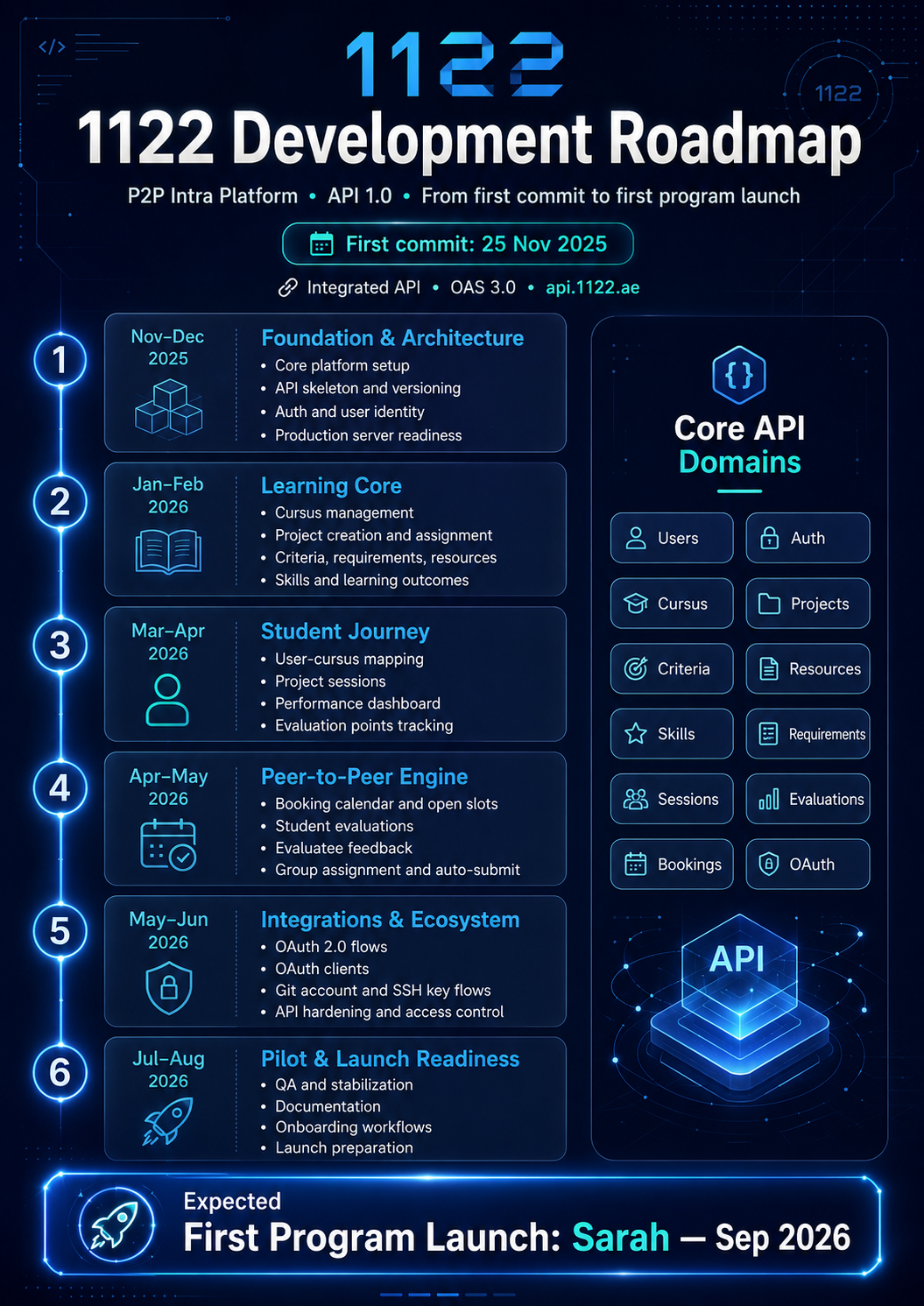
First commit: 25 November 2025
Platform: 1122 P2P Intra Platform
API version: API 1.0
Standard: OAS 3.0
Production endpoint: api.1122.ae
Expected first program launch: Sarah — September 2026
1122 is not building another learning website.
1122 is building the infrastructure of a new learning system: peer-to-peer, project-based, measurable, and designed for the AI era.
The first commit of the 1122 was made on 25 November 2025. That date marks the beginning of the technical foundation behind the 1122 methodology. From that point, the platform started moving from idea to architecture, from architecture to API, and from API to a full learning engine.
The integrated API 1.0 is the backbone of this roadmap. It connects users, cursus, projects, skills, requirements, evaluation points, bookings, peer evaluations, feedback, OAuth, Git accounts, and learning outcomes into one unified system.
This is the roadmap from first commit to first program launch.
Why This Platform Matters
Learning has changed.
In the AI era, content is everywhere. Explanations are everywhere. Tutorials are everywhere. The real challenge is no longer access to information. The challenge is building people who can think, build, collaborate, evaluate, adapt, and prove their competence through real work.
That is why 1122 is not centered around passive lessons.
1122 is centered around projects, peer learning, evaluation, feedback, and progression.
The 1122 Intra is designed to make that possible at scale.
It is the system that allows every learner to have a clear path, every project to have measurable requirements, every skill to be tracked, every evaluation to be structured, and every program to become a real learning journey.
Development Timeline
Phase 1: Foundation & Architecture
November – December 2025
The first phase focused on building the foundation of the platform.
This stage was about setting the technical direction correctly from the beginning. A learning platform that wants to scale cannot be built randomly. It needs clean architecture, clear API versioning, authentication, user identity, and production readiness.
Key work included:
- Core platform setup
- API skeleton and versioning
- Authentication and user identity
- Production server readiness
- Initial structure for future learning modules
This phase established the base of the 1122 ecosystem.
Phase 2: Learning Core
January – February 2026
Once the foundation was ready, the next priority was the learning core.
This is where the platform started becoming more than a user system. It became a learning system.
The core modules included cursus management, project creation, project assignment, project criteria, resources, requirements, skills, and learning outcomes.
Key work included:
- Cursus creation and management
- Project creation and assignment
- Project criteria
- Project requirements
- Project resources
- Skill mapping
- Learning outcomes
This phase made it possible to structure a complete program inside the platform.
Phase 3: Student Journey
March – April 2026
A platform is only useful if the learner journey is clear.
This phase focused on how a student enters a cursus, sees available projects, starts a project session, tracks progress, and understands performance.
The student journey is one of the most important parts of 1122. It must be clear, direct, and motivating. Learners should not feel lost inside a platform. They should always know where they are, what is next, and what they need to improve.
Key work included:
- User-cursus assignment
- Student project listing
- Registered, unlockable, and locked project states
- Project session registration
- Project start flow
- Student performance dashboard
- Evaluation points tracking
This phase connected the learner to the learning path.
Phase 4: Peer-to-Peer Engine
April – May 2026
1122 is built on peer-to-peer learning.
That means evaluation is not an afterthought. It is part of the methodology.
The peer-to-peer engine allows learners to book evaluation slots, evaluate each other, receive feedback, and participate in a structured evaluation culture. This is where the platform starts reflecting the real 1122 philosophy: learning by doing, learning by explaining, and learning through interaction.
Key work included:
- Evaluation booking system
- Open evaluation slots
- Evaluator calendar
- Student pending evaluations
- Evaluation submission using evaluation codes
- Evaluatee feedback
- Feedback sentiment and comments
- Evaluation counts per project session
This phase is critical because peer learning cannot rely on informal interaction only. It needs structure, traceability, and accountability.
Phase 5: Integrations & Ecosystem
May – June 2026
A serious learning platform cannot live in isolation.
This phase focused on integrations and ecosystem readiness. The platform includes OAuth 2.0 flows, OAuth clients, token management, Git account updates, SSH key access, and audit flows for GitLab accounts.
This is important because 1122 is not only tracking learning. It is connecting learning with the tools used by real builders.
Key work included:
- OAuth authorization
- OAuth token flow
- OAuth user information
- OAuth client management
- Client secret rotation
- Git account update
- SSH key access
- GitLab account audit
- API hardening
- Access control improvements
This phase prepared the platform to connect securely with other systems and future 1122 tools.
Phase 6: Pilot & Launch Readiness
July – August 2026
The final pre-launch phase is about stabilization.
A platform is not ready because the features exist. A platform is ready when the flow works, the experience is clean, the documentation is clear, and the program can run without confusion.
This phase focuses on preparing the platform for the first program launch.
Key work includes:
- QA and stabilization
- Full user flow testing
- API documentation review
- Program onboarding workflow
- Evaluation flow validation
- Admin and learner experience testing
- Launch preparation
This phase turns the platform from a product under development into an operational learning environment.
Core API Domains
The integrated API 1.0 includes the main domains required to run the 1122 learning experience.
Users
The user module handles authenticated user details, full user profiles, profile photos, Git accounts, SSH keys, password updates, and performance dashboards.
This is the identity layer of the platform.
Auth
The authentication module handles registration, login, refresh tokens, and secure access to the platform.
This is the access layer.
Cursus
The cursus module allows the creation, update, deletion, and assignment of learning paths.
This is how 1122 organizes programs.
Projects
The project module manages project creation, listing, assignment, group assignment, auto-submit, Git audits, and project updates.
This is the execution layer of the methodology.
Criteria
The criteria module defines how projects are evaluated.
Without criteria, evaluation becomes subjective. With criteria, evaluation becomes structured, fair, and repeatable.
Resources
The resources module allows projects to include files, videos, references, and supporting material.
This gives learners the material they need without turning the platform into a passive content library.
Skills
The skills module connects projects to the capabilities they develop.
This allows 1122 to track not only what learners complete, but what they actually build as competence.
Requirements
The requirements module defines what a project expects from the learner.
It gives structure to delivery, validation, and progression.
Project Sessions
Project sessions allow learners to register, start, update, and complete projects.
This is how the platform tracks real learning activity.
Evaluation Points
Evaluation points support the peer-to-peer model by giving learners the ability to participate in evaluations and manage their evaluation balance.
This supports responsibility and contribution within the learning community.
Bookings
The booking module manages evaluation slots, open calendars, available bookings, cancellations, pending evaluations, and evaluation counts.
This is the scheduling engine of the peer-to-peer system.
Evaluations and Feedback
The evaluation module allows evaluators to submit full evaluations and allows evaluatees to submit feedback after the evaluation.
This closes the learning loop.
A project is not complete only when it is submitted. It is complete when it is evaluated, discussed, and understood.
OAuth and OAuth Clients
The OAuth modules prepare 1122 for secure integrations with external applications and future ecosystem tools.
This gives the platform long-term extensibility.
Expected First Program Launch: Sarah - September 2026
The expected first program launch is planned for September 2026 with Sarah.
This launch represents more than the opening of a program.
It represents the first real validation of the 1122 platform, methodology, and infrastructure working together.
By that stage, the platform is expected to support:
- User onboarding
- Cursus assignment
- Project-based learning
- Peer-to-peer evaluation
- Evaluation bookings
- Performance tracking
- Skills mapping
- Feedback collection
- Secure integrations
Sarah will be the first proof that 1122 can move from concept to execution.
What This Roadmap Says About 1122
The roadmap shows one clear thing:
1122 is being built with intention.
Not as a simple LMS.
Not as a content platform.
Not as another online course website.
1122 is being built as a peer-to-peer learning infrastructure for people who want to build real skills.
The API is not only technical work. It is the structure behind the learning philosophy.
Every endpoint exists for a reason.
Users exist because identity matters.
Cursus exists because learning needs direction.
Projects exist because skills are built by doing.
Criteria exist because evaluation must be clear.
Bookings exist because peer learning needs structure.
Feedback exists because growth needs reflection.
OAuth exists because the ecosystem must be open and scalable.
This is how 1122 moves.
From first commit.
To first program.
To a new way of learning.
1122 is not waiting for the future of education.
1122 is building it.